NOCTOGENESIS

How Evolution Assembles Novelty

Evolution is not in dispute.The mechanism is.

Evolution didn’t wait. It prepared.

Noctogenesis proposes that major evolutionary innovations must be assembled genetically before being exposed phenotypically to natural selection. Genetic changes accumulate while their effects remain latent, allowing the components of complex, multi-threaded adaptations to develop outside the immediate demands of phenotypic fitness. When the necessary architecture is sufficiently developed and integrated, it is expressed as a functional whole and only then becomes subject to natural selection, which would have otherwise pruned an incomplete (and possibly maladaptive) biological system.

THE BOOKS

TWO WAYS INTO NOCTOGENESIS

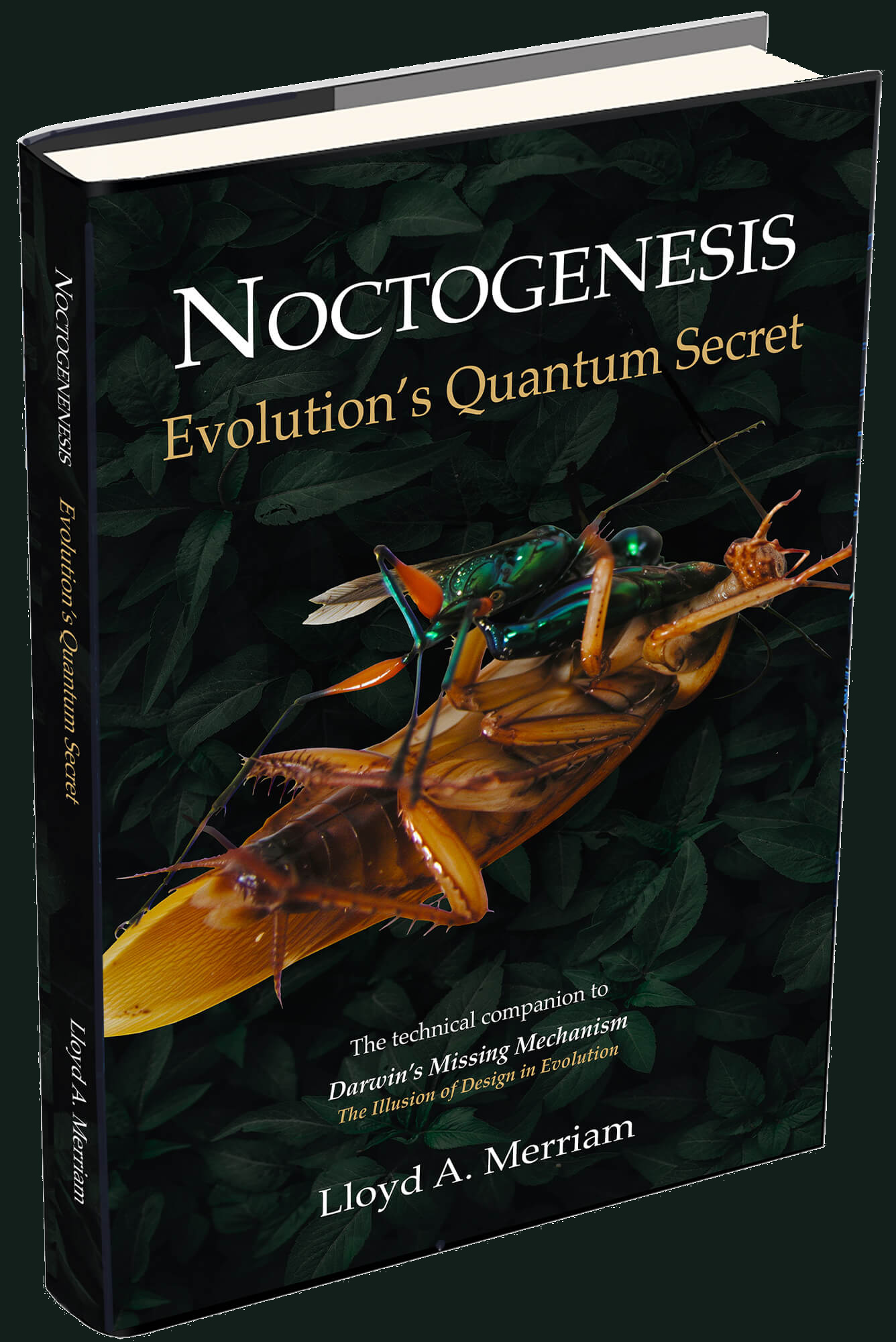
Hardcover edition of Noctogenesis: Evolution’s Quantum Secret by Lloyd A. Merriam

The full technical treatment of Noctogenesis. The book examines where Noctogenesis departs not only from the Modern Synthesis but from contemporary alternatives within evolutionary biology, including the "Extended Evolutionary Synthesis," and the "Third Way" of evolution. It develops the biological case for latent genetic architecture and the pre-expressed accumulation of evolutionary novelty, then proposes a mechanism rooted in non-classical (quantum) physics to explain how evolutionary variation itself can be assembled before natural selection ever encounters it.

VIEW ON AMAZON →
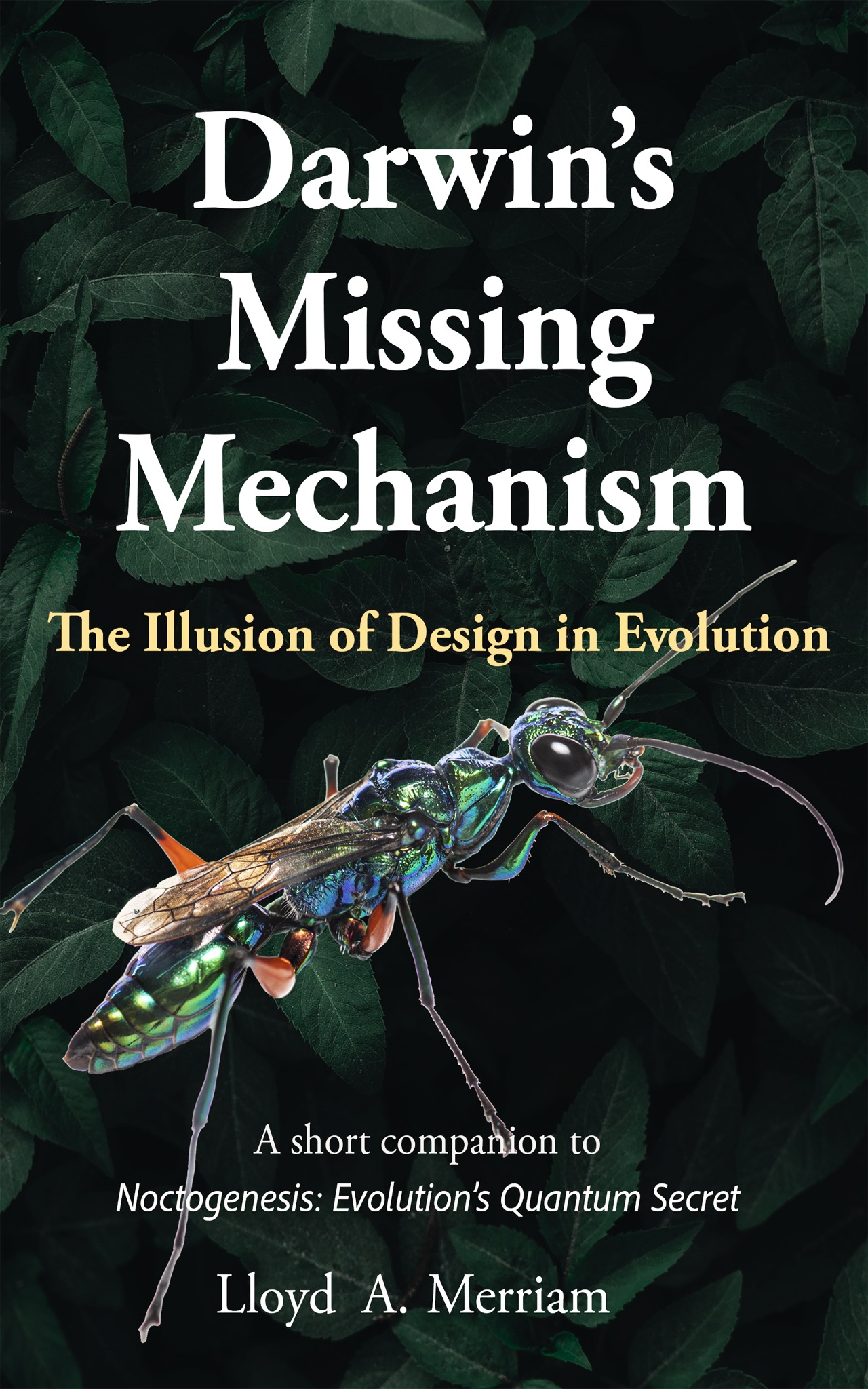
Cover of Darwin’s Missing Mechanism: The Illusion of Design in Evolution by Lloyd A. Merriam

A shorter, more accessible introduction to the central problem addressed in the more technical Noctogenesis: Evolution’s Quantum Secret. Darwin’s Missing Mechanism focuses on the apparent design of complex biological adaptations and asks whether mutation and natural selection, operating through intermediate forms that must provide an immediate selective advantage, are sufficient to explain how tightly integrated evolutionary novelty originates. It introduces the Noctogenesis alternative without requiring the reader to follow the larger book’s full biological and quantum-mechanical treatment.

VIEW ON AMAZON →

RESEARCH

THE PAPERS

The research papers develop specific parts of the Noctogenesis argument, examine its predictions, and document the scientific evidence bearing on its central claims.

01

NOCTOGENESIS: A Non-Classical Account of Evolutionary Innovation

Lloyd A. Merriam

The principal academic statement of Noctogenesis, presenting its proposed non-classical mechanism for the origin and coordinated emergence of biological novelty.

READ THE PAPER →
02

Twelve Studies on the Early Origin of Key Developmental Genes Prior to the Cambrian Explosion

Lloyd A. Merriam

An examination of twelve studies bearing on the early origin of developmental genes and regulatory architectures before their later phenotypic deployment.

READ THE PAPER →

NEWS

IN THE NEWS

17 AUGUST 2026 · openPR

Logistics Expert Asks a Question Biology Has Overlooked: How Does Evolution Assemble Coordinated Novelty?

The jewel wasp precisely alters a cockroach’s nervous system, suppressing its impulse to escape. For Lloyd A. Merriam, the remarkable thing is not simply what the wasp does—it is everything evolution had to coordinate before it could do it.

READ THE RELEASE →

ESSAYS

NOCTOGENESIS ON SUBSTACK

Essays on evolutionary biology, quantum biology, consciousness, philosophy, natural wonders, dissenting scientific ideas, and other questions that extend beyond noctogenic theory itself. The Substack is also where the Noctogenesis argument continues to develop in public.

READ ON SUBSTACK →

RESEARCH PROFILE

Lloyd A. Merriam

Lloyd A. Merriam is an independent researcher and author who originated Noctogenesis, a proposed non-classical account of evolutionary novelty. Drawing on nearly two decades of study in evolutionary biology, developmental genetics, quantum physics, and philosophy of science—and an earlier career developing complex logistical systems—he examines how coordinated biological innovations could arise before natural selection can act upon them. His current research focuses on latent regulatory architecture, evolutionary developmental biology, and experimentally distinguishable alternatives to conventional co-option.